
Performing Umrah is a deeply fulfilling spiritual journey that Muslims undertake to seek divine forgiveness, renewal, and closeness to Allah Almighty. To ensure that this sacred act of worship is accepted, one must perform its core rites and obligations in their prescribed sequence. This guide outlines the essential steps of Umrah in exact chronological order, from adopting Ihram to final completion.
Preparing for Ihram and Understanding the Miqats
Preparation for Umrah begins with personal purification before crossing the boundaries of Ihram. It is recommended for the pilgrim to perform ghusl (full body wash), clip nails, trim unwanted bodily hair, and apply personal scent to the body without touching the Ihram garments. A man wears two seamless white sheets (an Izar around the waist and a Rida over the upper body) and sandals, while a woman wears modest, loose-fitting ordinary clothes without displaying adornments, abstaining from wearing face veils (Niqab) or gloves while in Ihram.
Pilgrims must enter Ihram at or before passing the designated geographical boundaries known as the Miqats:
- Dhu al-Hulayfah (Abyar Ali): The Miqat for residents of Madinah and those passing through it. It is the furthest Miqat from Makkah (around 420 km).
- Al-Juhfah (today pilgrims enter Ihram from Rabigh): The Miqat for people of the Levant (Sham), Egypt, the Maghreb, and those traveling from their direction, located around 186 km from Makkah.
- Qarn al-Manazil (Al-Sayl al-Kabir, paired with Wadi Muharram on the Taif-Al Hada route): The Miqat for the people of Najd (including Riyadh and Qassim), Taif, and travelers from the east, around 75 to 80 km from Makkah.
- Yalamlam (Al-Sadiyah): The Miqat for the people of Yemen and those arriving from the south, around 100 km from Makkah.
- Dhat Irq (Al-Daribah): The Miqat for the people of Iraq and those arriving from the northeast, around 100 km from Makkah.
- Those residing within the Miqat zones (such as residents of Jeddah) assume Ihram from their place of residence. Residents of Makkah who wish to perform Umrah must exit to the boundaries of Al-Hill, the closest being Al-Taneem (Mosque of Aisha).
- Air travelers must enter Ihram when aligning with the Miqat in flight and are not permitted to cross it without Ihram. They should prepare beforehand on the ground or in the plane, declaring their intention as the flight approaches the Miqat line.
Entering Ihram, Chanting Talbiyah, and Observances
Ihram is the primary pillar of Umrah, representing the formal spiritual intention (Niyyah) coupled with specific rites. At or parallel to the Miqat, the pilgrim makes the intention in the heart and utters: Labbayk Allahumma Umrah (Here I am, O Allah, for Umrah).
Immediately after entering Ihram, the pilgrim begins reciting the Talbiyah aloud for men (and quietly for women): Labbayk Allahumma Labbayk, Labbayka La Shareeka Laka Labbayk, Innal-Hamda Wan-Ni'mata Laka Wal-Mulk, La Shareeka Lak. The recitation continues frequently until the start of Tawaf at the Kaaba.
Once in Ihram, several prohibitions must be observed according to the well-known scholarly consensus:
- Shaving, trimming, or plucking hair from any part of the body.
- Cutting or clipping nails.
- Applying fragrance or perfume to clothes or body after declaring the intention.
- Men covering their heads with fitted headgear (such as caps or turbans); holding an umbrella for shade is permitted.
- Men wearing stitched garments (such as shirts, trousers, and underwear).
- Women wearing face veils (Niqab) or gloves; they may drape a fabric over their face in front of unrelated men without fastening it tightly.
- Contracting marriage, proposing, or engaging in sexual relations and their preludes.
- Hunting or disturbing wild land game.
Should an inadvertent violation occur or if an urgent necessity arises, pilgrims are advised to consult recognized religious scholars regarding the appropriate expiation.
Entering Al-Masjid Al-Haram and Tawaf
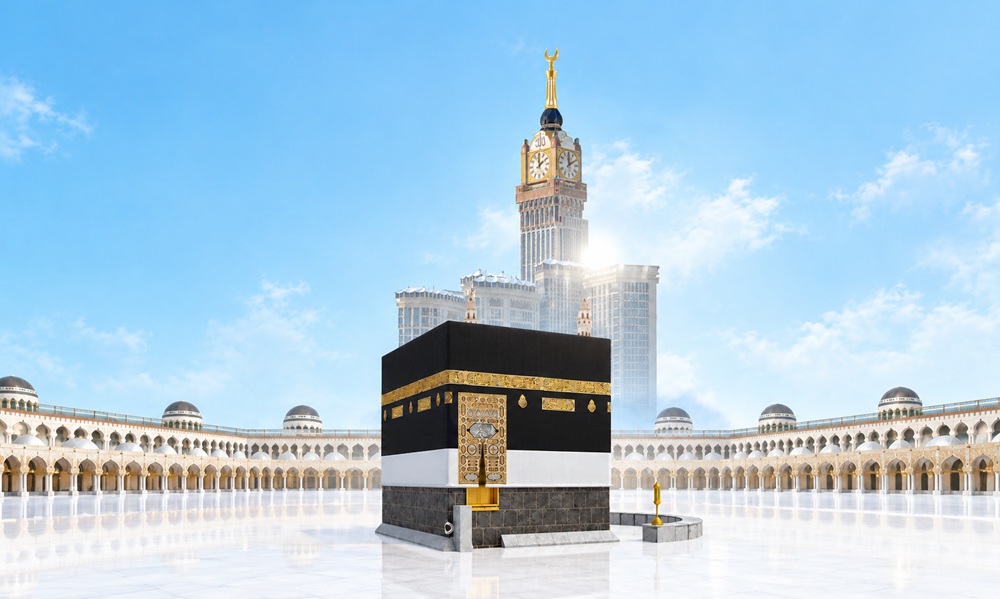
Upon reaching Makkah and entering the Sacred Mosque, it is sunnah to step in with the right foot and recite the supplication for entering a mosque: Bismillah, was-salatu was-salamu 'ala Rasulillah, Allahummaftah li abwaba rahmatik. The pilgrim stops the Talbiyah once facing the Kaaba to begin Tawaf.
Tawaf is the second pillar of Umrah, requiring physical purity (Wudu) and covering the Awrah:
- Men practice Idtiba by uncovering the right shoulder, placing the middle of the upper sheet under the right armpit and draping both ends over the left shoulder.
- Tawaf starts at the corner of the Black Stone. The pilgrim stands parallel to it, gestures toward it with the right hand, and says: Bismillahi, Allahu Akbar, without pushing or harming others.
- The pilgrim circumambulates the Kaaba counterclockwise for seven complete circuits, keeping the Kaaba to the left.
- Men perform Ramal (brisk walking with short, fast steps) during the first three rounds only, resuming a normal walking pace for the remaining four circuits.
- Touching the Yemeni Corner with the right hand is recommended if accessible without crowding. Between the Yemeni Corner and the Black Stone, it is sunnah to recite: Rabbana atina fid-dunya hasanah wa fil-akhirati hasanah wa qina 'adhaban-nar.
- Pilgrims are free to recite Quran, supplicate for worldly and spiritual welfare, or engage in Dhikr, as there are no mandated private texts for individual circuits.
Praying Behind the Station of Ibrahim and Zamzam
Upon finishing the seventh round, men cover their right shoulder with the upper garment. The pilgrim moves toward Maqam Ibrahim (Station of Abraham) if possible and performs two brief rak'ahs. It is sunnah to recite Surah Al-Kafirun in the first unit after Al-Fatihah, and Surah Al-Ikhlas in the second. If the area behind the station is crowded, this prayer can be performed anywhere inside the mosque.
After the prayer, it is recommended to drink from the blessed well of Zamzam until thoroughly quenched, pour some over one's head if desired, and make sincere personal supplications before walking toward the hills of Safa and Marwah.
Sa'i Between Safa and Marwah
Sa'i constitutes the third pillar of Umrah, consisting of seven laps starting at Safa and concluding at Marwah:
- Ascending or standing near Mount Safa, the pilgrim recites the Quranic verse: Innas-Safa wal-Marwata min sha'a'irillah. Facing the Qiblah, the pilgrim praises Allah, proclaims His greatness, and makes heartfelt supplications three times with raised hands.
- The pilgrim walks toward Marwah with dignity and tranquility. Between the two green fluorescent markers, men are encouraged to pick up pace into a light jog if manageable without causing distress, whereas women walk at a regular pace throughout the course.
- Reaching Marwah completes the first lap. The pilgrim turns toward the Qiblah and supplicates just as on Safa, without repeating the initial Quranic verse.
- The process is repeated for seven laps; moving from Safa to Marwah counts as one lap, and returning from Marwah to Safa counts as another, concluding the seventh lap at Marwah.
- Maintaining ritual purity (Wudu) is preferable during Sa'i, though according to the well-known opinion, Sa'i remains valid if performed without it.
Tahallul: Shaving or Trimming the Hair
The final obligatory act to complete Umrah is cutting or shaving the hair (Tahallul):
- Men have the choice between shaving the entire head (Halq) with a razor or cutting the hair evenly across all sides (Taqsir). Shaving is widely recognized as superior for men due to the Prophet's triple supplication of mercy for those who shave compared to once for those who trim.
- Women do not shave their heads; rather, they gather their hair and trim an amount roughly equal to a fingertip (around 2 cm).
Once the hair is cut or shaved, the state of Ihram ends completely. All standard restrictions—including personal grooming, everyday clothing, and perfumes—are now lifted, and the Umrah is successfully concluded by the grace of Allah.
Planning your spiritual journey with clarity brings peace of mind and allows you to focus fully on worship. Visit Omraway to compare verified Umrah packages, review itineraries, and select the ideal pilgrimage arrangements tailored to your preferences with comfort and trust.